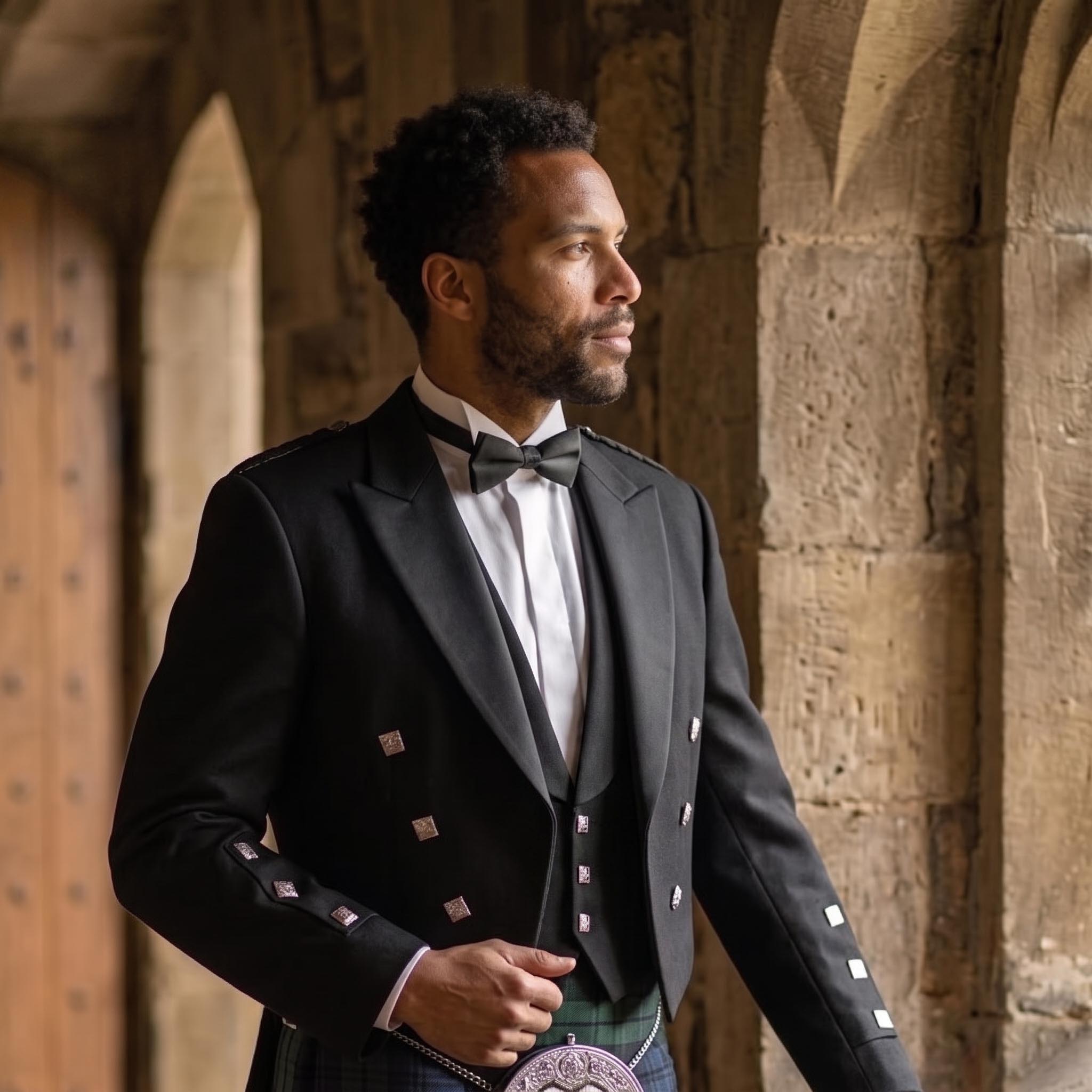

What Is a Full Kilt Outfit? Every Piece Explained

Quick answer: A full kilt outfit is the complete set of Highland dress worn together. That means a tartan kilt, a kilt jacket and waistcoat, a shirt, a sporran with its chain, a kilt belt and buckle, a kilt pin, kilt hose (socks) with flashes, and ghillie brogues. Most outfits also add a tie or bow tie, and some include a sgian dubh, which is the small knife worn in the sock. Bought separately, these are hard to match. That's why most men buy a complete kilt outfit where every piece is already chosen to go together.
If you've been invited to a Scottish wedding or a Burns supper and the dress code says "Highland dress", this guide covers what each piece is, why it's there, and what you can skip.
Every Piece of a Kilt Outfit at a Glance
|
Piece |
What it is |
Essential or optional |
|
Kilt |
Pleated tartan garment wrapped around the waist |
Essential |
|
Jacket |
Prince Charlie (evening) or Argyll/tweed (day) |
Essential for formal events |
|
Waistcoat |
Matching vest worn under the jacket |
Essential with a jacket |
|
Shirt |
White wing collar, standard dress shirt, or ghillie shirt |
Essential |
|
Tie or bow tie |
Tartan tie, black bow tie, or tartan bow tie |
Usually worn |
|
Sporran |
Pouch worn at the front, since a kilt has no pockets |
Essential |
|
Sporran chain |
Holds the sporran around the hips |
Essential |
|
Kilt belt and buckle |
Wide leather belt with a decorative buckle |
Common, but often skipped under a waistcoat |
|
Kilt pin |
Weighted pin on the front apron |
Essential |
|
Kilt hose |
Knee length socks, usually cream, white, or black |
Essential |
|
Flashes |
Small tartan tabs on garters that show below the sock turnover |
Essential |
|
Ghillie brogues |
Laceless tongue shoes with long laces tied around the ankle |
Strongly recommended |
|
Sgian dubh |
Small knife tucked into the right sock |
Optional |
The Kilt: Where Everything Starts
The kilt sets the tone for the whole outfit. Everything else is chosen to go with the tartan you pick.
When you're choosing a kilt, two things matter most.
Fabric length. You'll usually see kilts sold as 5 yard or 8 yard. That number is how much fabric goes into the pleats.
-
An 8 yard kilt has deeper, fuller pleats. It swings and hangs like a traditional kilt and suits weddings and formal dinners.
-
A 5 yard kilt is lighter, cooler, and easier on the budget. It works well for ceilidhs, festivals, or a first kilt.
You can see the difference by comparing our traditional 8 yard Prince Charlie outfit with a lighter Hunting Stewart 5 yard set.
The tartan. If your family has a clan tartan, wear it. If not, universal tartans such as Black Watch, Pride of Scotland, or a plain grey or black sett are perfectly correct for anyone. Browse the full range in our tartan kilts collection.
How it should fit: the kilt sits at your natural waist, a couple of inches above your trouser waistband, and the hem should land around the middle of your kneecap. If you remember only one fitting rule, make it this one, because most badly worn kilts are simply too long.
The Jacket and Waistcoat: Day or Evening?
The jacket you choose decides how formal you look. You'll mostly see two styles.
Prince Charlie jacket. This is the black evening jacket, cut short at the front with tails at the back and silver buttons. It's worn with a matching three or five button waistcoat. Pick this for black tie weddings, formal dinners, Burns suppers, and anything after 6pm. It's the most popular choice for grooms.
Argyll or tweed jacket. This is a shorter, plainer jacket, often in tweed or wool, with leather or horn buttons. It suits daytime weddings, christenings, graduations, and country events. Grey tweed looks especially sharp in photos without feeling stiff. Our grey tweed 9 piece outfit is a good example.
If you already own a kilt and only need the top half, look through our kilt jackets and vests.
What if there's no jacket? For a ceilidh, a casual summer wedding, or a festival, plenty of men skip the jacket and wear a ghillie shirt with the kilt. It's relaxed and comfortable, and still traditional.
The Shirt and Tie
Match the shirt to the jacket.
|
Jacket |
Shirt |
Neckwear |
|
Prince Charlie |
White wing collar or white dress shirt |
Black bow tie or tartan bow tie |
|
Argyll or tweed |
White or light dress shirt |
Tartan tie matching the kilt |
|
No jacket |
Ghillie shirt (laced at the neck) |
None |
A tartan tie that matches your kilt ties the whole look together. You'll find matching options in our tartan ties range.
The Sporran: Your Pocket, and More
A kilt has no pockets, so the sporran carries your phone, wallet, and keys. It hangs from a chain around your hips and sits at the front, roughly a hand's width below your belt buckle.
There are three broad types:
-
Day sporran: plain leather, sometimes with tweed. It goes with Argyll and tweed jackets.
-
Semi dress sporran: leather with a decorative metal or embossed front. It's the most versatile type.
-
Dress sporran: fur or hair with tassels and a metal cantle (the decorative top piece), often with a thistle, stag, or lion rampant badge. It's worn with a Prince Charlie in the evening.
If your outfit's sporran doesn't suit the occasion, swapping it is the easiest upgrade you can make. See our full sporran collection.
Belt, Buckle and Kilt Pin
Kilt belt and buckle. A wide leather belt with a large buckle, often Celtic, thistle, or stag head. With a Prince Charlie and waistcoat you can leave it off entirely, because the waistcoat covers the waist. Without a waistcoat, the belt is what makes the outfit look finished.
Kilt pin. It goes on the front apron, the outer layer of fabric, on your right side about 4 inches up from the hem and 2 inches in from the edge. It adds weight so the apron hangs straight. Pin it through the top layer only, never through both layers, or the kilt won't move properly when you walk.
Kilt Hose, Flashes and Garters
Kilt hose are thick knee length socks. Fold the tops over so the turnover sits about two or three fingers below the knee.
Colour guide:
-
Cream or off white is the classic choice for most occasions.
-
White is common at weddings.
-
Black is popular with Prince Charlie outfits and with modern looks.
Flashes are the small tartan or coloured tabs that peek out under the turnover on the outside of each leg. They're attached to elastic garters that hold the sock up. Pick flashes that echo a colour in your kilt. Flashes and other finishing pieces are in our kilt accessories section.
Ghillie Brogues: The Right Shoes
Ghillie brogues have no tongue. Long laces wrap around your lower leg and tie just above the ankle. They look right with a kilt in a way ordinary shoes don't.
You can wear polished black Oxford shoes in a pinch. If the outfit is for your own wedding, though, get proper ghillies. Shop brogues and boots.
The Sgian Dubh
The sgian dubh (pronounced "skee en doo") is a small ceremonial knife tucked into the top of your right sock with only the handle showing. It's traditional, but it's optional. Check with the venue first, because some venues, airports, and public events won't allow any blade, even a decorative one.
How Many Pieces Do You Actually Need?
You'll see outfits sold as 5, 7, 9, 10, 11 or even 13 pieces. Here's what that usually means:
|
Set size |
What you typically get |
Best for |
|
5 piece |
Kilt, belt, buckle, sporran, kilt pin |
Ceilidhs, festivals, adding to a shirt you own |
|
7 to 9 piece |
Adds jacket, waistcoat, chain, flashes |
Day weddings, events |
|
10 to 11 piece |
Adds shirt, tie, socks |
Complete wedding outfit |
|
13 piece |
Adds shoes and extras |
Everything in one order |
Check the "What's Included" list on each product before you buy. Two 10 piece sets can contain different items.
How Much Does a Full Kilt Outfit Cost?
Prices in the UK vary a lot, depending on whether the kilt is pure wool or poly viscose and whether it's made to measure. At GNG Outdoor, a 5 piece set starts at around £66, and full Prince Charlie or tweed outfits with jacket, waistcoat, and accessories run from about £115 to £190.
Hiring a kilt outfit for one weekend often costs close to that. If you'll wear it more than once (a wedding, then Burns Night, then St Andrew's Day), buying usually works out cheaper.
Common Mistakes to Avoid
-
Wearing the kilt too low or too long. It belongs at the natural waist, with the hem at mid knee.
-
Pinning through both layers of the apron. Pin the outer layer only.
-
Mixing day and evening pieces, for example a fur dress sporran with a tweed day jacket.
-
Clashing tartans. Keep to one tartan, and let the tie and flashes match or echo it.
-
Ordering without measuring. Waist, hips, and drop (waist to mid knee) decide the fit. Measure before you order.
Our Experience Dressing Kilted Gentlemen
At GNG Outdoor, the question we get most is "what do I need for a wedding?" The answer is nearly always a Prince Charlie or Argyll outfit of 10 or more pieces in a tartan that suits the wedding party. Most of our sets come in more than 50 tartans, and grooms often order matching outfits for the whole party so the photos look consistent. If you're unsure which tartan or set size suits your event, get in touch through our contact page and we'll help you choose.
Frequently Asked Questions
What is included in a full kilt outfit?
A kilt, jacket, waistcoat, shirt, tie, sporran with chain, belt and buckle, kilt pin, kilt hose, flashes, and ghillie brogues. A sgian dubh is optional.
What do you wear under a kilt?
That's up to you. Tradition says nothing, but most men today wear fitted dark underwear or shorts, especially at weddings and dancing events.
Can I wear a kilt outfit to a wedding if I'm not Scottish?
Yes. Wearing a kilt is a mark of respect for Scottish tradition. If you don't have a clan, choose a universal tartan such as Black Watch or a plain grey tartan.
What is the difference between a Prince Charlie and an Argyll outfit?
A Prince Charlie is the black evening jacket with tails, worn for formal and black tie events. An Argyll is a plainer, shorter jacket, often in tweed, worn during the day.
How long should a kilt be?
The bottom edge should reach the middle of your kneecap when you stand straight.
Is a 5 yard or 8 yard kilt better?
An 8 yard kilt has fuller pleats and a more traditional look for formal events. A 5 yard kilt is lighter and cheaper, and it's ideal for casual wear or a first kilt.